
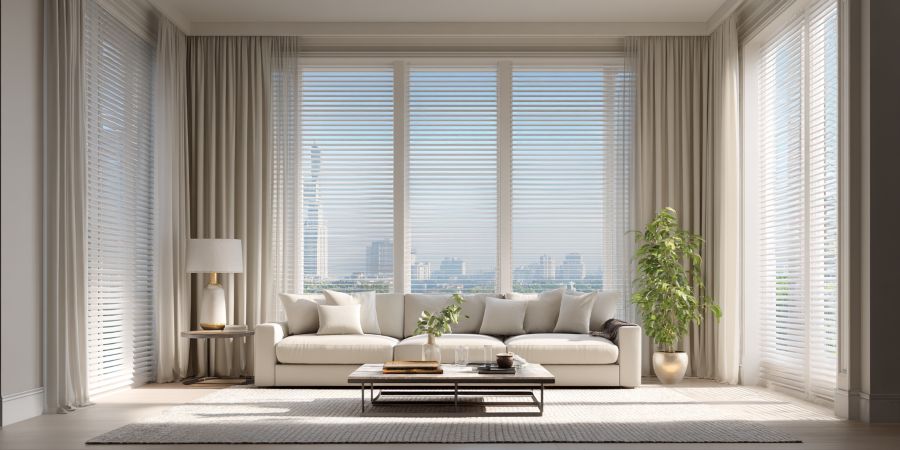
Your Blinds Are Aging Faster Than Your Windows
The spray-and-wipe routine most homeowners trust is quietly dulling faux wood blinds. Here's what causes yellowing and the simple weekly fix.
Part 3 of 3 in the series The Faux Wood Files: What Your Blinds Aren't Telling You.
Part two of this series looked at the finishing choices that make a set of blinds read as custom instead of builder-grade. Now comes the part nobody warns you about: even a beautifully specified, perfectly hung set can go dull, yellow, and slightly sad within three or four years. Not from age. From care.
This series was shaped throughout by product guidance from Blinds Chalet, whose long experience with faux wood construction helped us separate the myths about upkeep from what actually protects a finish. And the biggest myth is this: that cleaning blinds means spraying something on them.
Here is the short version. Faux wood blinds are PVC or a PVC and wood composite. That material has a surface finish, and often a UV inhibitor blended into it. Most household cleaners are built to cut grease on sealed countertops. Used on vinyl, they strip, soften, and slowly chemically age the surface. Once that happens, the slat stops reflecting light evenly and starts absorbing it. That is what your eye reads as yellow.
Three Culprits, Ranked by How Much Damage They Do
Homeowners usually blame sunlight. Sunlight is real, but it is rarely first on the list.
- Ammonia and bleach-based sprays. The single fastest way to yellow a white slat. Ammonia attacks plasticizers in vinyl. The slat gets chalky, then brittle, then discolored, usually starting at the bottom rail where overspray collects.
- Kitchen airborne grease. Cooking oil aerosolizes, drifts, and lands on horizontal surfaces. Slats are horizontal surfaces. That film traps dust, and the dust-plus-oil layer bakes into a warm amber tone that looks exactly like sun damage but wipes off if you catch it early.
- Cigarette, fireplace, and candle residue. Soot is fine enough to bond into the texture of an embossed woodgrain slat. It does not dust off. It needs to be lifted.
Sunlight comes fourth, and it mostly matters on the exposures that already run hot, which is why west-facing rooms fail at almost every comfort test you throw at them. On those windows, the blind is absorbing heat all afternoon, and heat accelerates every chemical process already underway on the slat surface.
Why It Shows Up in Winter
Low winter sun enters the room at a shallow angle and rakes across the face of your blinds instead of hitting them from above. That sidelight is unforgiving. It reveals every uneven patch, every streak, every slightly ambered slat near the stove or the fireplace. People call us in January convinced their blinds changed overnight. They did not. The light changed.

The Fix Is Dry, Fast, and Boring
The routine that keeps faux wood bright takes about five minutes per room and involves almost no liquid. That is the whole trick. Dust is the delivery system for everything that discolors a slat. Remove the dust weekly and the grease film, the soot, and the chemical residue never get a chance to bond.
Step by Step
- Close the slats one direction. Tilt them fully closed so the face forms a flat panel. Do not try to dust individual slats with the blind open. You will bend them and you will miss half the surface.
- Dust top to bottom with a microfiber cloth or a lambswool duster. Long vertical strokes, light pressure. Microfiber grabs particles instead of pushing them around.
- Reverse the tilt and repeat. The back face collects just as much, especially on the window side where condensation and dust mix.
- Hit the headrail and bottom rail. These are dust shelves. Ninety percent of people skip them.
- Run a dry cloth along the ladder cords or tapes. Cords yellow faster than slats and they sit right at eye level.
That is it. Weekly in kitchens and rooms with a fireplace. Every two or three weeks everywhere else.
When You Do Need Moisture
Twice a year, or after cooking season, a slat needs more than dusting. Use a cloth dampened with plain warm water and, if you must, one drop of clear dish soap in a quart of water. Wring the cloth until it is barely damp. Wipe one slat at a time, then follow immediately with a dry cloth. Never leave standing moisture in the routing holes, and never let water sit against the headrail where the tilt mechanism lives.
What stays under the sink: ammonia glass cleaner, bleach wipes, magic erasers, abrasive powders, and anything labeled "heavy duty degreaser." Melamine foam erasers in particular sand off the finish layer. The slat looks clean for a week, then yellows faster than the ones you never touched.
One more note on material. The guidance from Blinds Chalet that stuck with us most is that composite slats and solid PVC slats do not behave identically. Composites handle scrubbing pressure better but absorb more moisture at cut edges. Solid PVC shrugs off humidity but shows scratching sooner. Know which one is hanging in your window before you decide how aggressive to be with it.

Discoloration Is Not the Only Slow Failure
Yellowing gets the attention because it is visible. Sagging is the quieter problem, and it usually means something structural is happening. A slat that bows in the middle on a wide window is almost always under-supported, which loops right back to the sizing and spec decisions covered when "perfect fit" trap that leaves first came up in this series. Standard faux wood has a practical width limit. Past it, you need an extra ladder cord run, a heavier gauge slat, or a two-on-one bracket setup.
Quick Diagnostics You Can Do From the Floor
- Uneven bottom rail. One side hangs lower than the other. Usually a cord lock or a lift cord that has slipped, not a bad install.
- A single slat curling upward. Localized heat. Check whether a vent, lamp, or unshaded glass hot spot sits directly behind it.
- Slats that will not tilt together. The tilt rod has disengaged from the wand mechanism in the headrail. Ten-minute fix, no replacement needed.
- Yellowing only near the top. Almost always heat rising and collecting at the headrail, not sun.
Heat is worth taking seriously here. The same radiant load that warps a slat is the one behind the glass coating mistake that damages furniture and flooring on exposed elevations, and a window covering alone cannot fix a glazing problem. If your slats are warping on one specific window and nowhere else, the window is telling you something.
Where Vertical Slats Change the Math
On sliders and tall openings, gravity works with you instead of against you. Hanging slats do not sag across a span, they do not collect dust on a horizontal face, and they wipe down in a single pass. Homeowners who fight recurring discoloration in a bright family room often do better with textured grain vertical blinds on the large glass and horizontals everywhere else. It is not a compromise. It is matching the product to the way dirt actually travels through a room.
The visual payoff matters too. Clean, evenly toned slats are half of what makes a room look intentional, a point that surfaced again when your neighbor's faux wood blinds became the focus earlier in this series. A gorgeous valance cannot rescue slats that have gone three shades warm.
Closing the File on Faux Wood
Across three parts, the pattern has been consistent. Faux wood blinds do not fail dramatically. They fail slowly, in small increments, through decisions that felt harmless at the time. A mount depth guessed rather than measured. A valance chosen from a thumbnail. A bottle of blue spray cleaner grabbed on a Saturday morning. Each one small. Together, they are the difference between blinds that look sharp for fifteen years and blinds that look tired in four.
The good news is that none of the fixes are expensive or difficult. Measure honestly, spec for the heat and humidity the window actually sees, choose the finishing details deliberately, and then dust more and spray less. Five minutes a week, a dry microfiber cloth, and the discipline to leave the ammonia under the sink will do more for the look of your windows than any product you can buy. Winter light is coming, and it shows everything. Give it nothing to find.
To request a free estimate on Windows replacement, Sliding glass doors or french doors, call us today!

Get An Instant Quote!
We’ll deliver Your Custom Quote Within 24 Hours!