
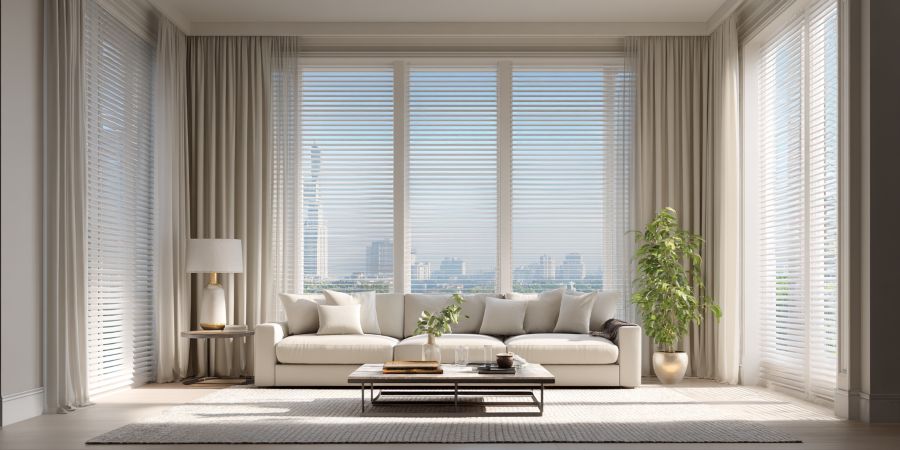
The Small Details That Make Blinds Look Expensive
Valance style, lift type, slat routing and undertone decide if faux wood blinds read designer or builder-grade. Here's what separates the two.
Part 2 of 3 in the series The Faux Wood Files: What Your Blinds Aren't Telling You.
Part one of this series looked at how mount type, slat width and humidity ratings quietly decide whether your blinds stay flat or bow by August. Now comes the part nobody warns you about: two houses on the same street can install the exact same faux wood blinds, in the same color family, and one set looks like it came from a design studio while the other looks like it came with the house.
The difference is almost never price. This series was shaped in part by product guidance from Blinds Chalet, whose faux wood catalog makes something clear the moment you compare options side by side: the spec sheet details most shoppers skip are exactly the ones your eye picks up from across a room.
Start at the Top: Valance Profile and Returns
The valance is the horizontal piece covering the headrail. It is the most visible part of a blind when the slats are open, and the part builders cheap out on first. A standard valance is a flat strip of faux wood, roughly three inches tall, screwed straight across the front; it hides the mechanism and nothing else. A crown or dentil valance adds profile, depth and a shadow line, and that shadow is what tricks the eye into reading the blind as millwork instead of hardware.
What separates the two in practice:
- Return ends. A valance with returns wraps around the sides of the headrail so you never see the bracket. Without them, you see raw metal from any angle that isn't straight on.
- Height proportion. On a tall window, a three inch flat valance looks undersized; a taller or profiled one balances the opening.
- Finish match. Valance and slats should come from the same production run. Order them separately, or replace one later, and you will see a color shift under afternoon light.
- Clip placement. Cheap installs leave visible clips at the top edge. Better systems hide them behind the profile.
If you only upgrade one thing on a set of faux wood blinds, upgrade the valance. It costs a fraction of the total and changes the read of the whole window.

What a Dangling Cord Does to a Window
A hanging cord chain is a visual line running down one side of your window. Multiply that by five windows in a living room and you have five dangling verticals your eye keeps catching. Nothing dates a window faster.
Cordless lift systems remove that line entirely. You lift the bottom rail by hand, it stays where you put it, and the window reads as a clean rectangle. This is why nearly every staged home you have admired uses cordless and builder packages almost never do: cordless costs more per unit, and in a 40-window spec home that adds up fast. It is also the safer choice in any home with kids or pets, and the default on most modern lines. For a bedroom or playroom, options like 2 inch cordless blinds solve the aesthetic and the safety problem in one decision rather than two.
There is a middle option: a cord lock with a cleat, where the cord wraps neatly around a wall-mounted hook. Better than a loose dangling loop, but still a visible cord. Treat it as a budget compromise, not a design choice.
Wand Versus Cord Tilt
Tilt control is a separate decision from lift. A tilt wand is a slim clear or color-matched baton. A tilt cord is a pair of small dangling strings with plastic ends. The wand looks intentional; the cord looks like an afterthought, and the two strings never hang at the same length for long. On wide windows a wand also gives you better leverage, so slats tilt evenly instead of catching partway across, which matters a great deal in rooms where light control is the whole point, the same reason "perfect fit" trap that leaves deserves attention before you order anything.
Slat Routing: The Detail Almost Nobody Names
Every faux wood slat has holes punched through it so the ladder cords can pass. Those holes are the routing, and standard routing puts them about an inch and a half in from each edge, in a straight vertical line down the blind. When the slats are closed, light pours through every one of them: two glowing columns of pinpricks, plus a third if the blind is wide enough to need a center support. In a bedroom or a media room, that is the difference between dark and almost dark.
Routeless slats move the cord to the outside edge or use a notch design so no hole passes through the face of the slat. The result is a closed blind that actually closes, and a cleaner one, because the slat face is uninterrupted. Most people cannot name what changed; they just notice the window looks more solid.
Trade-offs, honestly: routeless slats sometimes tilt with slightly less overlap at the edges, and they usually add cost. On a west-facing bedroom, that cost is worth paying. On a laundry room window, it is not.

White Is Never Just White Next to Your Trim
Here is where most homeowners go wrong, and it happens before anything gets installed. They pick white. Then they discover their white blinds fight with their white trim.
Faux wood white comes in at least three common undertones: a cool bright white, a warm off-white, and a soft cream or antique. Your trim has an undertone too. A cool white blind against warm cream trim looks gray and plasticky. A cream blind against crisp bright trim looks dingy, like it has already aged.
How to Test It Properly
- Order physical samples. Screen colors are unreliable and showroom lighting is nothing like your living room.
- Hold the sample directly against the trim, not near it. A half inch gap hides the mismatch.
- Check morning, mid afternoon and under your evening lamps. Undertones shift hard with light temperature.
- Look at it from the street too. Blinds are exterior-facing whether you meant them to be or not.
Sheen and Grain
High gloss faux wood reads as plastic because gloss is what plastic does. A matte or low-sheen finish reads as painted wood. Under direct sun a glossy slat also shows every surface ripple, one more reason rooms that already struggle with heat and glare deserve extra thought, a problem covered in depth in why west-facing rooms fail every summer.
Grain embossing is a similar judgment call. Smooth slats pair with painted trim and modern interiors; embossed grain works with stained wood trim and traditional casing. Mixing them is where things look off, because a grain-embossed white slat next to flat painted trim reads as an imitation of something rather than as its own finish.
Installation Details That Give You Away
Even a well-specified blind can look cheap if it is hung carelessly. A few things that quietly announce a rushed job:
- Uneven light gaps. Inside-mount blinds should show a consistent gap on both sides. A quarter inch on the left and an eighth on the right will bother you forever once you see it.
- Bottom rail not level. Usually a cord tension issue, not a bracket issue, and fixable in minutes.
- Mismatched heights across a wall. Three windows in a row should have their headrails on the same plane, even if the openings differ slightly.
- Hold-down brackets skipped. On doors and in high-traffic spots, the bottom rail swings and knocks. The brackets come in the box and get left there.
Consistency across a room matters more than perfection at any single window. The eye reads a wall of blinds as one element, much like exterior choices read as a set, a lesson the window style snowbirds regret installing teaches the hard way.
The Gap Between Good Enough and Genuinely Good
None of this is about spending dramatically more. A crown valance with returns, a cordless lift, routeless slats and an undertone that actually agrees with your trim might add fifteen or twenty percent to a project. What they add to the finished look is not proportional. They are the difference between a window covering and a finished window.
The other half of the equation is what happens after the install, because even a perfectly specified blind can turn dull, streaky or faintly yellow within a couple of years if it gets cleaned the wrong way. That is where this series goes next: the habits and household products quietly working against your slats, and the short routine that keeps them looking new.
To request a free estimate on Windows replacement, Sliding glass doors or french doors, call us today!

Get An Instant Quote!
We’ll deliver Your Custom Quote Within 24 Hours!