

Why Snug Blinds Bow Before the Summer Ends
Faux wood blinds bow and stick for reasons most homeowners never see coming. Here is what measuring, mount type and slat specs really decide.
There is a moment every homeowner recognizes. You ordered faux wood blinds in March; they went up crisp and tailored. By mid-July one panel sags in the center, another rubs the frame every time you lift it, and the slats no longer close flat against each other. Nothing broke. And yet the whole set looks tired six months in.
This series was shaped in part by insights from Blinds Chalet, whose long experience with faux wood product lines helped clarify which specs actually matter once a blind has to live through a full temperature swing.
Because warping is rarely a manufacturing defect. It is almost always the delayed result of a measurement, a mount choice, or a spec box clicked without much thought. The blind was doomed at the order form, not at the window, and once you see how those small choices connect, that form stops being a gamble.
What Faux Wood Actually Is, and Why That Matters
Faux wood blinds are usually PVC, a PVC composite, or a wood-and-polymer blend. That material is why they survive bathrooms and kitchens where real wood would swell and split, and it is also why they behave the way they do in heat. PVC expands when it warms — not dramatically, but measurably. A 60-inch slat can gain a small fraction of an inch across a hot afternoon and give it back overnight. Do that a few hundred times in a season, in a window that gives the slat nowhere to go, and you get a permanent bow. Add gravity acting on an unsupported span and the bow becomes a smile shape you cannot unsee. The goal is not a blind that never moves. It is one with room to move without fighting the frame.
The "Perfect Fit" Instinct Is the Problem
Most people measuring for the first time want the blind to fill the opening edge to edge. Tight gaps look clean and light leaks feel like a mistake. But a blind measured to the exact opening has zero tolerance. Manufacturers already take a small deduction off inside-mount orders, typically a quarter to a half inch depending on the brand, specifically so the headrail and slats have breathing room. Add a little extra on top of your measurement to close the gap and you cancel that tolerance out.
The result shows up on the hottest week of the year. Slats catch on the jamb, the bottom rail hangs crooked because one side is binding, tilting feels stiff. And once a slat has pressed against a frame through a few heat cycles, it holds that shape.
- Measure the opening, not the blind you want. Take the width at three heights and the height at three widths, then report the numbers honestly.
- Use the narrowest width for inside mount, and let the factory deduction do its job.
- Do not round up. Round down to the nearest eighth of an inch on width.
- Check for square. Measure both diagonals. If they differ by more than a quarter inch, an inside mount will show it.
That last point sends more homeowners to outside mount than any other, and it should.
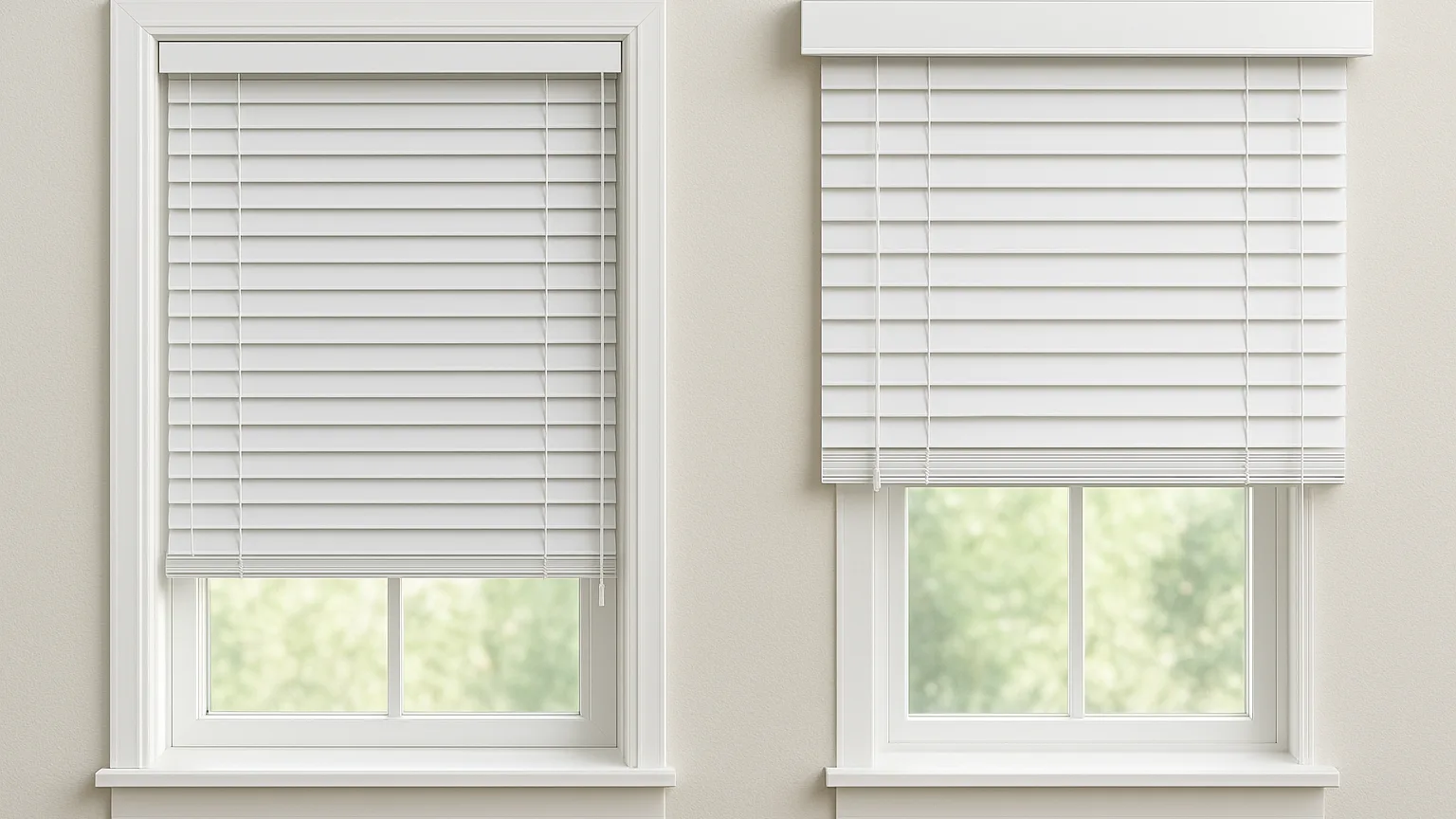
The Mount Choice That Forgives a Crooked Opening
Inside mount is the look most people picture: the blind sits within the window frame, the trim stays visible, and the whole thing reads as built in. It is also the less forgiving option by a wide margin. It demands adequate depth for the headrail, a reasonably square opening, and a frame with no obstructions like cranks or deep sill stops. Miss any of those and the blind either protrudes awkwardly or binds against something. In older homes, where settling has pulled openings out of square by half an inch or more, inside mount is a visible problem the day it goes up and a mechanical problem by summer.
When Outside Mount Is the Smarter Call
Mounting on the wall or trim above the opening solves several issues at once. The blind clears the frame entirely, so expansion has somewhere to go, out-of-square openings disappear behind the panel, and light gaps shrink because the blind overlaps the frame on all sides.
- Shallow frames where the headrail would protrude anyway
- Casement or crank windows with hardware inside the opening
- Openings out of square by more than a quarter inch
- Rooms needing real darkness, like bedrooms and media rooms
- Windows you want to look taller, since mounting high adds visual height
The trade is that outside mount needs flat wall or trim to land on, plus adequate overlap: at least an inch and a half to two inches past the opening on each side, and three inches above for the headrail bracket. Anything less and you lose the benefit.
Slat Width Is a Weight Decision, Not a Style Decision
The choice between two-inch and two-and-a-half-inch slats gets pitched as aesthetics: wider slats, fewer lines, more view through. All true. What rarely gets said is that wider slats are heavier, and weight is what makes a wide blind sag. Under about 36 inches, slat width is genuinely a preference. Past 48 inches it becomes structural. A two-and-a-half-inch PVC slat spanning 60 inches with no center support will bow under its own weight before heat ever enters the picture, and once it bows the stack never closes evenly again.
Composite slats, which blend wood fiber with polymer, run stiffer and lighter than solid PVC at the same width — the quiet upgrade worth paying for on wide windows. On large openings where light control and sightlines both matter, homeowners often pair sizing choices with privacy faux wood blinds that close tighter through a routless slat design, which also removes the pinholes that undermine a wide panel visually.
The Split You Should Ask For
Any opening wider than roughly 72 inches should be quoted as two blinds on a shared headrail rather than one giant panel. You get a narrow center seam instead of a sagging bottom rail. Most people never notice the seam. Everyone notices the sag.
The Heat Rating Hiding in the Fine Print
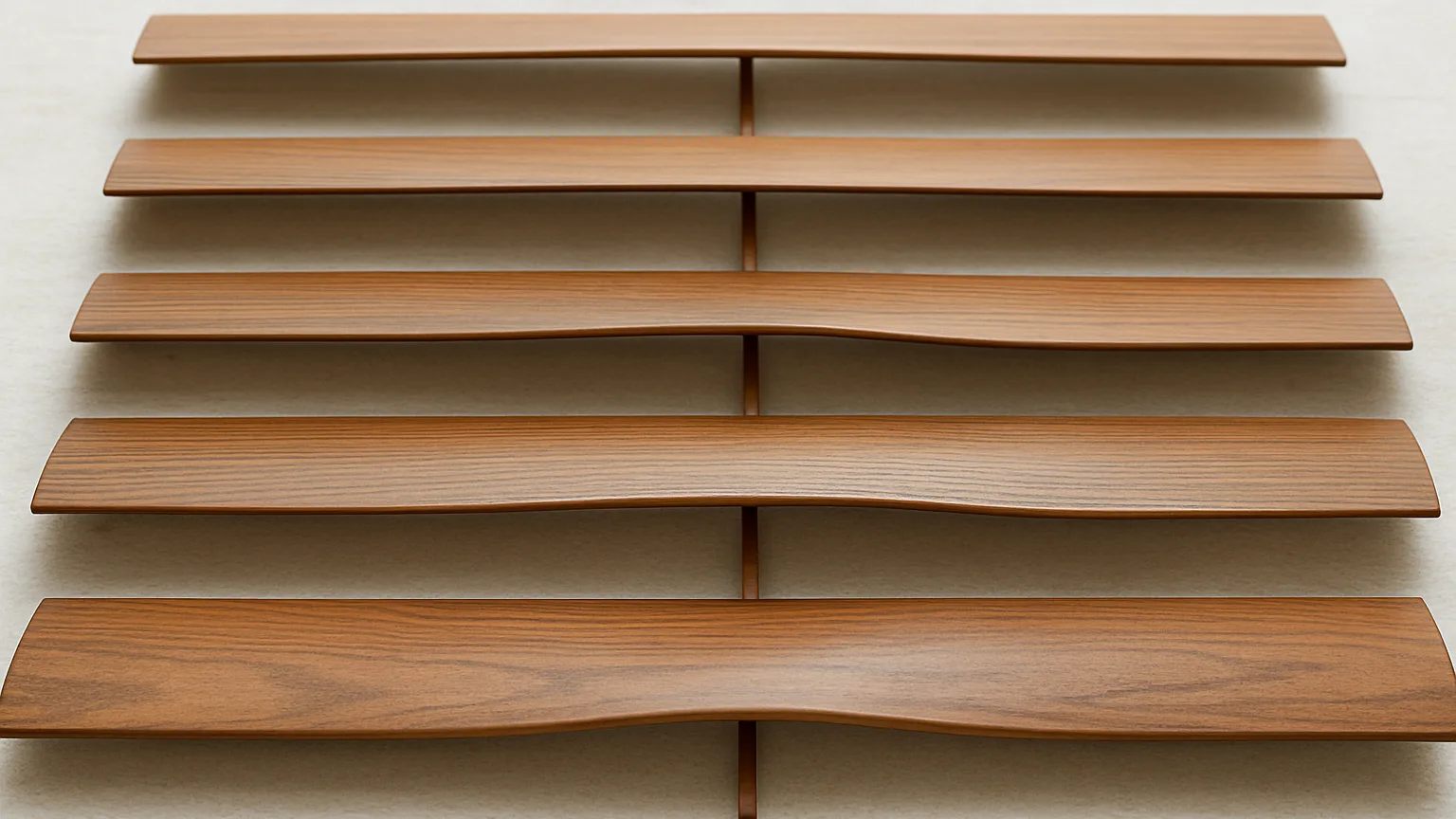
Faux wood is sold as the moisture-proof option, and largely it is. Humidity will not swell it the way it swells real wood. Heat is the variable that actually causes trouble, and heat is what most product descriptions gloss over. The number worth hunting for is a heat tolerance or maximum service temperature rating. Better faux wood lines include UV inhibitors and heat stabilizers in the PVC formulation, which is what separates a slat that holds its shape at 140 degrees from one that softens at 110. A south or west window behind glass can easily hit those temperatures on the slat surface in summer, even in a room that feels comfortable. Homeowners dealing with rooms where west-facing rooms fail every summer are asking their blinds to absorb punishing afternoon load, and a budget slat will not survive that assignment for long.
Where Faux Wood Struggles Most
- West-facing windows with unfiltered late-day sun
- Sunroom and enclosed patio glass where trapped air superheats
- Windows above heat sources, including radiators and kitchen ranges
- Tight-fitting inside mounts that trap air between slat and glass
- Dark colors on sunny exposures, which absorb noticeably more heat
Color matters more than people expect. An espresso slat on a west window can run significantly hotter than a white one in the same opening, the same climate math behind the window style snowbirds regret once an Arizona summer arrives. If the room demands a dark finish, that is one more reason to move up to a composite slat with a proper heat rating.
Glazing Changes the Equation
The glass in front of the blind sets the thermal conditions the blind lives in. Low-E coatings, tints and reflective films all cut the radiant load reaching the slats, but some coatings redirect heat in ways that create hot spots, an effect covered in detail when a glass coating mistake melting nearby surfaces shows up on a patio or sill. The same concentrated energy that damages furniture will deform a slat. Guidance from Blinds Chalet consistently points toward specifying for the harshest window in the house rather than the average one, which explains a lot about the window style snowbirds regret installing in desert markets, where seasonal residents spec for the winters they experience and not the summers they miss.
A Short Checklist Before You Click Order
- Measure three times across width and height, record the smallest number
- Check diagonals for square before committing to inside mount
- Confirm frame depth against the manufacturer's minimum for flush mounting
- Split any opening over 72 inches into two panels on one headrail
- Choose composite over solid PVC on wide or sun-exposed windows
- Look for a stated heat rating, not just a moisture claim
- Rethink very dark colors on west and southwest exposures
Get those seven right and the blind you hang in spring still looks tailored in August. Get them wrong and no amount of careful handling will save it, which is also why the finishing details that separate builder-grade sets from your neighbor's faux wood blinds only pay off once the fundamentals underneath are sound.
The Order Form Is the Real Installation
Faux wood blinds do not warp because someone yanked a cord too hard or left a window open in the rain. They warp because a set of quiet decisions, made in a few minutes on a product page or a measuring sheet, left no margin for a material that moves when it gets hot. Tolerance, mount type, slat width, span, color and heat rating are not fine print. They are the whole difference between a blind that ages well and one that announces its age by midsummer. Most of those decisions are free or nearly free to get right: measuring carefully costs nothing, choosing outside mount for a crooked opening costs nothing, and splitting a wide window or stepping up to composite costs a little and saves a full replacement. Once the structure is sound, the conversation shifts to how refined the blinds actually look, and to keeping that finish bright through years of sun, dust and cleaning habits that quietly work against you.
To request a free estimate on Windows replacement, Sliding glass doors or french doors, call us today!

Get An Instant Quote!
We’ll deliver Your Custom Quote Within 24 Hours!